Martes, Pebrero 5, 2019

How to minimise the impact of Brexit

In this article, James Stephens, Managing Director of Offsite Solutions, the UK’s leading bathroom pod manufacturer, looks at the impact of Brexit on the construction industry and how taking an offsite approach can mitigate some of the economic uncertainty.

According to the RICS, UK construction could lose eight per cent of its workforce post-Brexit – around 200,000 EU workers. The availability of labour in urban centres is one of the biggest challenges created by Brexit and could lead to significantly higher project costs.

If there are restrictions in the movement of labour, there will be pressure on wage inflation, which could be as high as 15% because of the reduced labour pool. The fall in the value of sterling also means that the UK will be a less attractive work destination and no longer the first choice for construction workers.

Over the last 20 years, the ready availability of overseas labour has resulted in very low levels of apprenticeships in the UK. If these workers do return to their countries of origin, the UK simply does not have sufficient domestic labour to address the skills gap.

How offsite is helping to address Skills Shortages

Offsite manufacture uses lean production techniques and better management of resources. This facilitates more efficient use of permanent, highly trained, multi-skilled labour with less reliance on subcontracted trades and improved quality control.

In-situ construction requires around seven different trades and ten-15 operations plus the required drying times. With offsite manufacture, this is reduced to a single supplier, which means less risk of delays and simplified procurement and project management. 

Mitigating the risk of material cost increases
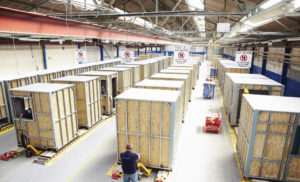
steel framed bathroom pods production line

It is estimated that at least a quarter of all materials used in UK construction are imported – underlining the susceptibility of the industry to currency fluctuations.

Reports from manufacturers and construction companies predict material price increases of up to 20% because of the rising cost of materials imports and the pressure of the weaker pound. There is also the possibility of additional duties if the UK loses the benefit of the single market and limits are imposed on quantities. 

We believe the use of offsite construction can mitigate the effects of Brexit because of the greater cost certainty it offers. The procurement of bathroom pods, for example, should be prioritised as the bathrooms will be delivered at an early stage in the project – even before the building envelope is installed. A better price can be agreed with early procurement and the risk of cost inflation can then be mitigated

The cost benefit of earlier procurement

As a bathroom pod manufacturer, we can achieve cost certainty because we have considerable buying power for bathroom products and materials – from taps, tiles and sanitary ware to timber, steel and oil-based materials for GRP. Long-term agreements with our supply chain give us the benefit of fixed annual prices. We place the orders for products and materials for the entire project as soon as our contract with the client is signed. Offsite manufacturers also have a more stable, longer-term, multi-skilled workforce and so are in a stronger position to protect against wage inflation.

With in-situ bathroom construction, several packages are tendered separately and typically at a later stage in the build programme. This leaves the contractor or developer much more exposed to cost increases for the finishing trades.

By entering into contract for factory-built bathrooms at an earlier stage, contractors and developers will secure a fixed price for one of the larger packages in a building project and at least 12 months ahead of the procurement process for in-situ bathroom construction. This provides critical certainty of cost and programme and removes the risk of wage inflation or material price increases.

Some positives resulting from Brexit

Whilst UK companies are having to grapple with higher costs, skills shortages and further pressure on the value of sterling, there are some positives resulting from Brexit.

Importing completed bathroom pods from Europe has become significantly more expensive. When this is combined with the longer lead times required for imports and the reduced responsiveness of manufacturers based outside the UK at the design stages, for delivery scheduling and in after sales, developers and contractors have been encouraged to focus on UK suppliers. As a result, we have seen much less competition from European bathroom pod manufacturers since the Brexit referendum which has had a very positive impact on our business and has to be good for British manufacturing and the offsite industry overall.


If you would like to read more articles like this then please click here.

The post How to minimise the impact of Brexit appeared first on UK Construction Online.


£500M affordable homes funding boost

The government has announced £500M in funding to develop more than 11,000 much-needed affordable properties across the country.

The funding boost, which will help the government towards its target of building 300,000 properties a year by the mid 2020s, was announced at the London First Building Summit.

By creating new strategic partnerships with Homes England, successful housing associations will have the freedom to spend the money on the developments where it can have the biggest impact.

In addition, a £9M funding deal has been agreed with Apex Airspace Developments which will see homes built on London rooftops. The first of the first of these homes will be completed by teh summer, with some 78 rooftop properties planned under the three year deal.

The properties – which will be built on five sites across the capital – are largely constructed off site before being winched on top of buildings, minimising disruption to residents. The revised planning rulebook encourages authorities to promote the use the airspace above existing residential and commercial premises for new homes.

Communities Secretary Rt Hon James Brokenshire MP said: “By providing targeted investment in affordable homes, and funding innovative projects to build rooftop properties, we are making our housing market work for everyone.

“Our £500M funding boost for housing associations will help them build thousands of extra affordable homes – including properties for social rent.

“These measures are all part of our plans to deliver 300,000 homes a year by the mid-2020s.”

Homes England Chairman, Sir Edward Lister said: “I welcome the new strategic partners who share our ambition to build better homes faster.

“Our new ways of working with the sector means that housing associations can use their funding flexibly across their development programmes and respond quickly to local housing demand and a changing market.”

The rooftop properties will be built in Tooting, Wanstead, Walthamstow, Putney and Wallington.

The Housing Associations to benefit from the funding – in the third wave of strategic partnerships – are: Bromford, Curo & Swan, Liverpool Mutual Homes & Torus, Longhurst & Nottingham Community Housing Association, Together, Walsall Housing Group, Yorkshire and Your Housing Group.

If you would like to read more articles like this then please click here.

The post £500M affordable homes funding boost appeared first on UK Construction Online.


Lunes, Pebrero 4, 2019

Southern SME builders under increasing pressure, says FMB

Rising material costs, a subdued housing market and an increasingly anxious banking sector could stifle construction industry growth, the Federation of Master Builders (FMB) has warned.

According to the Federation’s latest State of Trade Survey, workloads for southern SME builders remained broadly positive throughout Q4 2018. However, the FMB has raised serious concerns about the pressures SMEs now face.

In answer to the quarterly survey, 42% of SME builders said they had ‘detected’ signs of a subdued housing market first-hand. Complicating matters, one in five reported having a project stall in the past three months due to delayed loans or flat-out refusals from banks. The skills shortage also continues with carpenters overtaking bricklayers as the trade in shortest supply. Nearly two-thirds (64%) of SME builders have struggled to source carpenters or joiners, while 61% have had difficulty hiring bricklayers.

In response, expectations for the future have fallen for the third consecutive quarter. Just one-third (33%) of SME builders anticipate higher workloads during Q1 2019, down from 36% the previous quarter. 87% believe material prices will rise further in the next six months, up slightly from 86% in Q3 2018. Two-thirds (66%) expect wages and salaries to increase over the next six months however, up from 58% in the previous quarter.

According to Phil Hodge, Director of FMB South: “The developing skills crisis in particular is holding builders back in the south of England. There are rising shortages of carpenters, bricklayers and joiners, with two-thirds of firms struggling to hire in these key trades. A simple case of supply and demand means that these shortages are resulting in workers commanding higher wages which in turn puts pressure on margins for southern construction employers.

“Continued inflows of EU workers have so far served to mitigate this shortage and help the industry and economy continue to grow. But without this access to EU labour, there is a real possibility that skills shortages will further intensify, threatening the delivery of new housing with a knock-on effect on growth across the wider economy. The government therefore needs to seriously re-think the disastrous Immigration White Paper before irreparable damage is done.”

If you would like to read more articles like this then please click here.

The post Southern SME builders under increasing pressure, says FMB appeared first on UK Construction Online.


Next generation of rail system contracts awarded

Network Rail have confirmed the preferred bidders for its next generation of rail systems contracts.

The contract period covers the next decade of rail system – everything needed to make the rail system work including track, points, overhead lines and signalling –  in Scotland and the South of England.

Following an extensive tender period, Network Rail have awarded the track and rail system alliances in the South to Colas Rail and AECOM, and in Scotland to Babcock Rail, Arup and Arcadis. This announcement is subject to contract terms being finalised and agreed, with procurement currently operating a standstill period.

The ten year contracts are divided into three new geographically-focused alliances between Network Rail, designers and construction suppliers; North Alliance (Scotland route); Central Alliance (London North West, London North East and East Midlands route) and South Alliance (Anglia, South East, Wessex, Western and Wales routes).

Bidding continues on the Central alliance and a preferred bidder will be announced in due course following final verification and internal approvals. The three contracts in Scotland, Central and the South are work an estimated £5Bn over the term of the contracts.

Steve Featherstone, programme director Track, said: “Reaching this important milestone ensures we will have a stable foundation for the delivery of the Great Britain’s core railway infrastructure for the next decade. Our new strategy allows us to better align to the routes and ultimately, deliver for customers.”

Jean-Pierre Bertrand, CEO of Colas Rail Ltd, commented: “We are extremely proud of our team being recognised for the quality of the tender submission. We are fully committed to delivering major improvements to the UK railways in the South working together with our partners Aecom and Network Rail over the upcoming ten years.”

While Archie Bethel, Babcock International’s CEO, said: “Building on our long term relationship with Network Rail, we are delighted to have been selected as preferred bidder for this major programme of railway systems work, with our alliance partners Arcadis and Arup.  We look forward to working with Network Rail in the new alliance.”

Colin Wood, chief executive – Civil Infrastructure, Europe, Middle East and Africa, AECOM, said:  “We’re extremely pleased to be named, along with our partners Colas Rail, as a preferred bidder for the track and rail system alliance. We now look forward to working with Network Rail to deliver vital upgrades to Great Britain’s railway infrastructure over the next ten years.

“Reinforcing our position as one of the UK’s leading track and rail engineering renewal consultants, the award is testament to the reputation we’ve established and the trust we’ve built up over the years with Network Rail and Colas Rail as part of the S&C alliance.”

If you are interested in finding out more about key infrastructure trends today, you may wish to attend the flagship infrastructure exhibition at the NEC in April 2019 : UKIS 2019

Click here for more information on how to register or exhibit at the UK Infrastructure Show 2019.  

If you would like to read more articles like this then please click here.

The post Next generation of rail system contracts awarded appeared first on UK Construction Online.


Boosting building safety: What role can broadband play?

Following the Grenfell Tower tragedy and subsequent investigation, the issue of building standards and safety has rightly come into sharp focus in the construction and property industries. Indeed, there have been a number of government consultations on the issue, many of which focus on cladding and other materials used in construction. However, the benefits of digital infrastructure in improving building safety is not often considered by decision makers in the sector, says Jeremy Chelot, CEO of Community Fibre. Specifically, full-fibre networks have the potential to greatly improve building safety and efficiency, while laying the foundations for Smart building technology in the very near future.

Currently, the main reason given for landowners to have full-fibre installed on their premises is to provide better internet for their tenants. However, the potential benefits of this infrastructure are much broader than this. The unlimited and fast data that a full-fibre optic network delivers is often underappreciated, in that it can be used to enable a number of Smart and interconnected technologies which can greatly boost safety for residents and improve efficiencies for managers.

A prime example of these are Internet connected fire and intruder alarms, that can be made possible through full-fibre connections. Interconnected smoke alarms form an integrated system of protection for a building, therefore if one alarm in a building detects smoke, all interconnected alarms will sound- whilst also alerting offsite managers through their mobile and laptop devices. These devices are more reliable, thereby reducing risk and as a result, a building’s insurance premiums. Further to this, full-fibre will enable Smart door entry systems and remotely connected IP CCTV cameras, which help to improve a building’s overall security.

A full-fibre installation at a property can provide fast and almost unlimited bandwidth for your IP connected sensors and devices. Fibre optic cable has a small form factor, just 3mm diameter, and is passive and so does not need a power supply to operate. This makes it simple to install data-points in any part of a building and in locations where it makes most sense for your smart sensors to collect the most relevant data.

Fibre is the future foundation that will support the UK digital development and growth.  Installing a full-fibre network will ensure the bandwidth required to support security, safety and other building IoT devices will not impact the broadband speeds of the customers. By installing this digital foundation into buildings, customer, landowners and property managers alike can enhance the buildings smart technology as that technology advances over time, without having to worry about the bandwidth constraints these devices will have.

Of course, this technology is likely to become more prevalent in Smart Homes and buildings of the future, which also means that it is becoming increasingly important to consider the full-fibre infrastructure in the development and maintenance of a building.

Community Fibre recently completed its full-fibre installation at the 1,700 property Churchill Estate in Pimlico, London with many residents now receiving better and faster Internet services. The landlord wanted to install CCTV within the estate’s lifts to improve resident’s security whilst at the same time significantly improving their entrapment service. It was possible to provide very cost-effective data connectivity for the lift CCTV service because the fibre-optic foundation had already been installed.

The Government’s recent Future Telecommunications Infrastructure review sets an ambition to start turning the existing copper telecommunication networks off in 2030. Although this may seem a long way off, it should be remembered that procurement for in-building technologies can have life cycles of ten years or more. Therefore, landlords will need to start to think now about whether the technologies they are buying now will still operate with the full fibre-optic networks of the future.

As a result, it is encouraging to see digital infrastructure rise on the government’s agenda in recent years. The government’s target of getting all homes connected with full-fibre broadband within the next 15 years within its Future Telecoms Infrastructure Review is a key part of this. The review considers how the UK can speed up the switch from old and inferior copper-based internet cables, to fibre-optic cables in order to meet this target.

As a result of these ambitions, solutions that have previously relied on copper connections, such as lift alarms, telecare and significantly fire alarms, will need to be replaced with Internet Protocol (IP) devices. It is therefore vital that the construction industry plans ahead to make sure what they procure and install now will still be working after the copper switch off.

If you are interested in finding out more about key infrastructure trends today, you may wish to attend the flagship infrastructure exhibition at the NEC in April 2019 : UKIS 2019

Click here for more information on how to register or exhibit at the UK Infrastructure Show 2019.  

If you would like to read more articles like this then please click here.

The post Boosting building safety: What role can broadband play? appeared first on UK Construction Online.


Linggo, Pebrero 3, 2019

Homes England supports Teeside housing

Homes England are helping to support house building in Teeside with grant funding awarded to the North Star Housing Group to develop ten new, afforable homes in Thornaby.

The social housing developer has submitted a planning application to Stockton Borough Council which will see two-bedroom houses developed on a plot of cleared land on Millbank Lane. The appplication has been submitted in conjunction with developer PF Burridge, and if approved, will be the second development undertaken by North Star in the borough in the last 12 months.

The first development, which is coming to completion, comprises seven two-bedroom bungalows for the over 55’s in Darlington Lane.

Sarah Fawcett, Head of Development at North Star, said: “After the success of our Darlington Lane development we are very pleased to be working alongside Burridge Construction for a second time. If approved, this scheme will bring ten new homes, available for rent, near to Thornaby town centre. We know that the location will attract a lot of interest from those looking for high quality rented accommodation in this area.”

North Star is a group of housing associations operating across the North East and North Yorkshire, building and renting high quality affordable housing to meet a variety of needs, including specialist supported housing. The group is committed to creating homes and building futures as well as investing in people at every level.

Burridge Construction, which recently celebrated 50 years in business, is expanding into the new rented homes sector, having specialised in refurbishment work and commercial new build.

If you would like to read more articles like this then please click here.

The post Homes England supports Teeside housing appeared first on UK Construction Online.


Huwebes, Enero 31, 2019

A commitment to fix the system – the government’s response to the Grenfell Tower Report

We all recall the horrors of the Grenfell Tower tragedy on 14 June 2017 which resulted in the loss of 72 lives and many more being made homeless. The fire, which breached compartmentation of the block, represents the greatest loss of life in a residential fire in a century.

Following on from the tragedy, the government commissioned an independent review of the building regulations and fire safety to be led by Dame Judith Hackitt, an engineer and civil servant. On 18 December 2017 Dame Hackitt published her interim report in which she diagnosed issues with the current building safety regulatory framework and concluded that it was “not fit for purpose”. Subsequently, in May 2018, she published her final report which set out 53 recommendations to the government in order to address the deficiencies in the current regulatory regime. Dame Hackitt’s recommendations are wide in scope and cover everything from the planning phase of a higher risk residential building which is ten-storeys or more in height (and in some cases other buildings too) right through to BIM and building materials.

In this article, lawyers Ian Atkinson, Angela Lopes and Lucy Hadrill from Womble Bond Dickinson, focus on the government’s response to the Grenfell Tower Report and what this means for the construction industry.

The government’s implementation plan

On 18 December 2018 the government published its long awaited ‘Building a safer future – an implementation plan’ (the Plan), the government’s formal response to the recommendations set out in Dame Hackitt’s Independent Review of the Building Regulations and Fire Safety (May 2018) (the Review). The general response is that the government agrees in principle with the majority of the recommendations put forward by Dame Hackitt and will consult on the specific details in Spring 2019. The government has also confirmed that it “has not hesitated” to go beyond the scope of the Review where deemed appropriate and this is shown by the government’s recent ban of combustible cladding material from the external walls of new high rise homes over 18m, which the Review did not include. The government’s response is not surprising given the enormous political pressure to ensure that the tragic loss of lives caused by the Grenfell Tower fire is not repeated.

This article summarises the government’s response to the recommendations set out in chapters one (Parameters and principles of a new regulatory framework) and two (Design, construction and refurbishment) of the Review as they represent the recommendations most relevant to organisations active in the design, construction and refurbishment of higher risk residential buildings which are 10 storeys or more in height (HRRBs). Affected parties should also be conscious of the government’s response to the recommendations set out in chapters five (Competence), six (Guidance and monitoring to support building safety), seven (Products) and eight (Golden thread of building information) of the Review as they are also relevant to the industry. The Plan includes a useful consolidation of the government’s response to each recommendation at Annex A, which is available for further reading here.

The government’s response to chapters one and two of the Review

We have set out the recommendations made in chapters one and two of the Review, the government’s responses and our commentary in the table hereSome of the key recommendations include a new regulator for HRRBs, the JCA, as well as a new JCA Gateway approval process for HRRBs whereby developers will be required to obtain JCA clearance during three phases of development: the planning stage, before construction works commence and before occupation commences. In addition, Dame Hackitt also recommends a new change control process whereby variations during the construction phase of an HRRB will require prior approval by the JCA.

What does this mean for the industry?

There is no doubt that, if implemented in full, Dame Hackitt’s recommendations represent fundamental regulatory reform in the manner in which HRRBs are regulated in England and Wales. Whilst the construction industry welcomes the concept of safer homes, it will have to prepare itself to comply with any new regulatory regime and to take on board that the new regulatory regime may well result in additional cost, disruption and administration, particularly during the teething stage of the new regime. Developers and funders should also be conscious that the Review suggests extending aspects of the new proposed regulatory regime, such as items (ten) and (13) in the table, to cover MORBs which will result in even wider ramifications for the industry.

For now, the government has merely indicated its agreement in principle to some of the recommendations at this stage. The full extent and form of its implementation will be unclear until the consultation phase in the Spring. It is however interesting that the government has not indicated its unequivocal support for all of the recommendations made in chapters 1 and 2 of the Review. Only time will tell the precise extent of implementation by the government but, in the meantime, affected parties should continue to monitor developments and fully participate in the consultation process in order to shape the government’s decisions.

If you would like to read more articles like this then please click here.

The post A commitment to fix the system – the government’s response to the Grenfell Tower Report appeared first on UK Construction Online.