Lunes, Pebrero 11, 2019

Keynotes announced – UK Infrastructure Show

The UK Infrastructure Show is the UK’s premier supply chain event, focusing on connecting buyers and suppliers throughout procurement.

With infrastructure in the UK currently boasting a pipeline of £600Bn in projects, this vitally important sector offers a vast opportunity for suppliers looking to enter the infrastructure supply chain.

UK Infrastructure Show 2019 – part of the UK Public Sector Sourcing Expo – brings together major projects and programmes from some of the biggest spend areas within infrastructure, all under one roof.

Partners to the event encompass some of the biggest influencers in infrastructure, in both the public and private sector: such as the Department for Transport, National Infrastructure Commission, Crown Commercial Service, Scape Procure, Transport for West Midlands and HS2, with the Infrastructure and Projects Authority following up their successful appearance from 2018.

With key project pavilions including: HS2, Transport for West Midlands, WMCA and Midlands Connect – the show provides an opportunity to engage with representatives from some of the largest infrastructure projects on site in Europe today.

The Live Stage was a key focal point of 2018, with speakers keeping the audience abreast of the latest challenges in the infrastructure sector today. This year will be no different, with five exciting speakers already confirmed for the Live stage – and more announcements expected from the engagement and learning zones.

The UK Infrastructure Show 2019 Live Stage will host a range of the leading and most influential speakers from across the UK infrastructure marketplace.

Attendees will have an invaluable opportunity to hear directly from experts and policy makers as they present their views on the current and future landscape of infrastructure across the UK.

Kicking off on the keynote speeches will be Phil Graham, Chief Executive of the National Infrastructure Commission.

The NIC was established in 2015, following advice from Sir John Armitt for the government to form a Commission to advise it on future infrastructure strategy. The Commission has since produced a number of reports such as investigating the economic potential of the Cambridge-Milton Keynes-Oxford Corridor and how infrastructure can harness the opportunities presented by new technologies.

July 2018 saw the NIC publish the first National Infrastructure Assessment – spanning transport, energy, digital communications, water, flood resilience and waste, providing a blueprint for the infrastructure the UK needs to flourish over the next 30 years. Phil is sure to delve into the report and provide the audience with key insights.

Matthew Vickerstaff – Interim CEO of the Infrastructure and Projects Authority, will then take the audience through the National Infrastructure and Construction Pipeline. Providing an overview of the Authority’s projections, encompassing the projects which make up the £600Bn pipeline, Matthew will talk about improving delivery and performance of the major infrastructure projects.

Keynote Address 2 will be provided by Catherine De Marco OBE, Deputy Director Infrastructure Skills and Efficiency, Department for Transport.

Catherine is responsible for delivering the Transport Infrastructure Skills and Efficiency strategies. The Skills Strategy is aimed at increasing uptake of apprenticeships in transport, and two years on has successfully increased these by 22%, bucking the wider economic trend. With the skill shortage becoming ever more prominent in the engineering and construction industry, attracting talent to the sector is pertinent to the progress of the pipeline.

Finally we will hear from Scape Group, a public private partnerships delivering frameworks designed to provide social value through Infrastructure Procurement.

Adrian Hill, Acting Head of Frameworks, will take us through his role of developing, improving and managing the suite of national and regional frameworks within Scape Procure and how to create a strategic leadership of change and innovation to ensure that the framework services provide excellence and value to the public sector.

Part of the UK Public Sector Sourcing Expo, co-located with Procurex National 2019, and officially supported by CompeteFor and many of the major ongoing and future infrastructure projects, the UK Infrastructure Show 2019 will provide participants with a unique opportunity to engage, connect and collaborate with a vast array of key projects, decision makers and influencers representing the major areas of infrastructure, all in one day, under one roof

Register for your delegate place now.

If you would like to read more articles like this then please click here.

The post Keynotes announced – UK Infrastructure Show appeared first on UK Construction Online.


Building a renewable energy future

Compared with many countries, the UK has not done badly in developing renewable energy: so why is it now such a struggle getting new projects off the ground? And what can be done to improve things? Duncan Oswald, Senior Consultant at independent environmental consultant Eunomia, looks at the challenges and solutions for the sector.

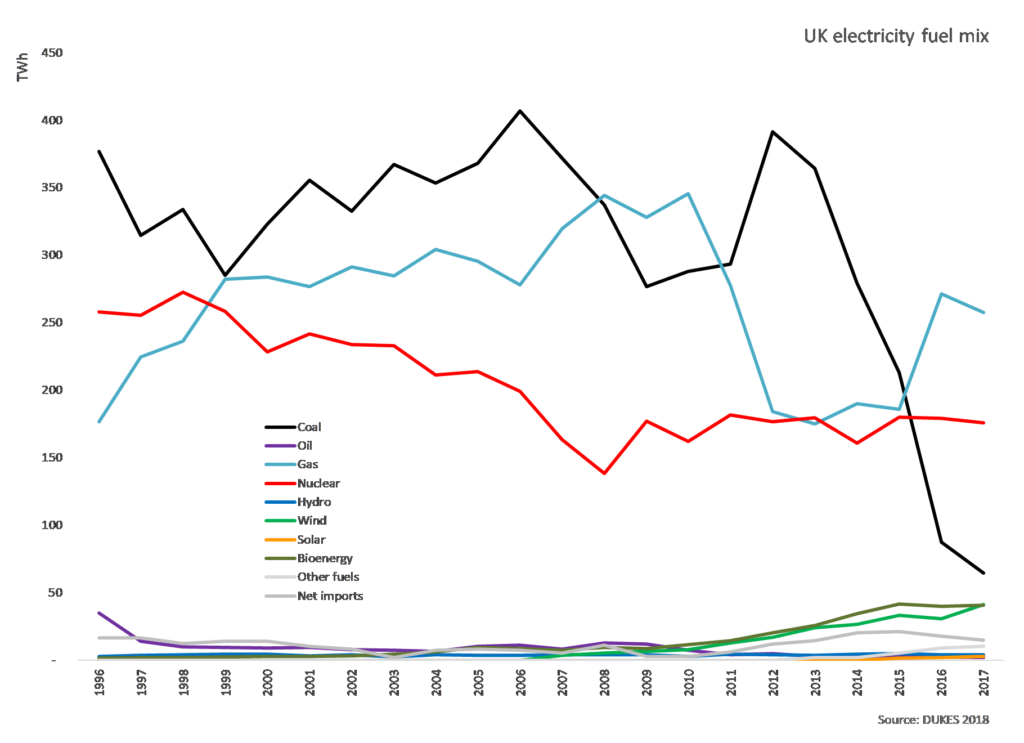
In the last ten years the UK has decarbonised its electricity grid more than any other country. Greenhouse gas emissions per kWh of electricity generated have halved, dropping from around 500g to approximately 250g. However, much of this is the result of coal being replaced by gas, with only a modest contribution from renewables. Data from the Digest of UK Energy Statistics (DUKES)[1] below shows the dramatic reduction in coal use in the past few years, and the modest contribution from renewables.

Compared with many countries, the UK has not done badly in developing renewable energy: so why is it now such a struggle getting new projects off the ground? And what can be done to improve things

In 2017, 81.1% of UK electricity was generated by the big three power sources: coal (10.5%), gas (41.9%) and nuclear (28.6%). Renewables in the broadest sense accounted for only 14.5%: wind (6.7%), bioenergy (6.6%), hydro (0.7%) and solar (0.5%).

The UK is facing a shortfall in electricity generation capacity. The demise of coal will continue[2] as the EUETS carbon price makes it increasingly expensive. Meanwhile, the UK’s ageing nuclear power fleet is slated for decommissioning by 2035[3]. The UK’s commitment to the Paris Agreement means that gas cannot be used to fill the gap and there are significant questions over whether adding more bioenergy would be beneficial. Given the climate in the UK, most of the energy needed will have to come from wind.

In the last ten years, wind generation in the UK has grown from almost nothing to a situation where you’re never far away from a wind farm. More importantly, wind is now contributing around 41TWh/yr to the country’s electricity generation. However, even if there were no increase in electricity consumption over the next ten years, the UK would need to add more than three times this level of development to make up the projected shortfall. Despite the UK’s early leadership in this area, it is crucial that we step up our action to ensure we can make up the difference in time.

Analysis presented in a recent Eunomia report[4] based on the BEIS Renewable Energy Planning Database shows a dramatic drop-off in renewable energy projects, including wind, as a result of policies implemented between 2012 and 2016. These include a de facto ban on planning permission for onshore wind and the precipitous removal of the Renewable Obligation (RO) scheme to avoid breaching the Levy Control Framework, designed to control the costs of supporting low carbon electricity. As a result, development of the cheapest form of renewable energy – onshore wind – has stopped, and new offshore wind projects have slowed to a trickle. Meanwhile, even though UK climate commitments require us to leave fossil fuels in the ground[5], the UK’s “Maximising Economic Recovery Strategy”[6] insists that we wring out every last drop.

The turn away from wind power doesn’t reflect popular sentiment. The latest (November 2018) report of the UK Government’s own regular Energy and Climate Change Public Attitude Tracker[7] shows that 80% of respondents support renewable energy. 66% said they would be happy to have a large-scale renewable development in their area. With onshore wind the cheapest form of energy generation – not just the cheapest renewable – it seems like an obvious area for the government to invest in and support. Instead, they are preventing developments that would be widely supported and could go ahead with little or no subsidy.

Calculation of subsidies is notoriously difficult[8] but by probably the most reliable estimate[9], the UK Government subsidises fossil fuels by more than renewables: dramatically more by some measures[10]. These subsidies make fossil fuel-based energy artificially cheaper, which in turn makes the financial case for renewable energy development more difficult. Climate breakdown is internationally recognised as the greatest threat to our ecology, economy and society, so why does the UK government continue to subsidise fossil fuel production? [11]

It used to be the case that North Sea oil and gas were net contributors to Treasury coffers so, while it might have been short-sighted, it was at least comprehensible that the sector was supported. However, this is no longer true[12]. Whatever the arguments for supporting the fossil fuel industry, there remains a political imperative to keep domestic and industrial energy bills down but it is unclear how distorting the market against the most popular, cost-effective and benign generation technology helps.

The shift from fossil fuels to renewable energy that we need is hampered by distortions in regulation and finance. The oil and gas sector is regulated to ensure that production is maximised, and subsidised to make it more competitive. The renewables sector is hamstrung by planning policy, receives considerably less financial support and has been damaged by inconsistent policy. However, the solution to all these problems is within easy reach.

Simply providing a level playing field would be enough to unleash the potential of the renewable sector. This could be readily achieved by removing subsidies from both (providing a welcome boost to the Treasury) and granting a presumption in favour of development to any site that is suitable for renewable energy (where there is no strong, demonstrable argument against it, such as the preservation of rare species and habitats).

These are cheap, popular actions that we can take right now that would put the renewable energy sector back on track to help the UK achieve its decarbonisation goals.

Duncan Oswald is a Chartered Environmentalist and Fellow of the Institute of Environmental Management and Assessment, ESOS Lead Energy Assessor and registered Environmental Auditor with 25 years’ experience in environmental consultancy. Duncan has worked with both public and private sector clients including UK public sector bodies and programmes such as Envirowise, Scottish Enterprise, HIE and Zero Waste Scotland, as well as a wide range of private sector companies, the Scottish Government, and a wide range of local authorities.


References: 

[1] http://bit.ly/2GBotIN
[2] http://bit.ly/2E27vBG
[3] http://bit.ly/2GBbuH8
[4] http://bit.ly/2E3LlyW
[6] http://bit.ly/2GBovjT
[7] http://bit.ly/2E3syE1
[8] http://bit.ly/2rnm2yz
[9] http://bit.ly/2E4LgLu
[10] http://bit.ly/2GASGI7
[11] http://bit.ly/2MGEMFp
[12] http://bit.ly/2nwE2Vh

If you are interested in finding out more about key infrastructure trends today, you may wish to attend the flagship infrastructure exhibition at the NEC in April 2019 : UKIS 2019

Click here for more information on how to register or exhibit at the UK Infrastructure Show 2019.

If you would like to read more articles like this then please click here.

The post Building a renewable energy future appeared first on UK Construction Online.

Construction firms warned of responsibilities by HSE

The HSE has reminded construction companies of their responsibilities after a worker was seriously injured on site.

A metal fabrication company was successfully prosecuted by the HSE following an incident on site where an agency worker was injured.

North Tyneside Magistrates’ Court heard how, on 15 March 2017, a welder recruited from an agency by W D Close and Sons Limited was instructed to carry out welding on top of a structure which required working at height. A five metre high tower scaffold was erected, but this was not suitable and unsecured boards were added to the working platform to give the required access for the work to be completed. Whilst moving from one part of the structure to another, the worker stepped on to one of the unsecure boards, which spun round and caused him to fall approximately five metres onto the concrete floor.

Serious injuries were sustained in the fall including a broken collarbone, several fractured ribs and a head injury. The worker spent ten days recovering in hospital before returning to his home in Poland.

An investigation carried out by the Health and Safety Executive found the company had failed to properly plan work at height and had failed to provide a safe working platform for the welders carrying out the required work. A suitable and sufficient risk assessment would have identified which equipment should have been used and how the work should have been carried out.

W D Close and Sons Limited of Valentia Avenue, Walkergate, Newcastle upon Tyne pleaded guilty to breaching Section 3(1) of the Health and Safety at Work Act 1974 and has been fined £200,000 with £1,398 in costs.

Speaking after the hearing, inspector Bill Gilroy said: “This case highlights the importance of properly planning work at height and ensuring it is carried out from a safe working platform and the proper equipment is used.”

If you would like to read more articles like this then please click here.

The post Construction firms warned of responsibilities by HSE appeared first on UK Construction Online.


Biyernes, Pebrero 8, 2019

Constructing the Future – research launched

At this crucial moment for both politics and economics in the UK, Construction Excellence are pleased to announce the launch of our recent research piece: Constructing the Future – the challenges and opportunities for the construction sector.

We are pleased to announce the launch of: Constructing the Future – the challenges and opportunities for the construction sector.

Construction is a major contributor to the UK economy. The built environment influences every part of our lives and the sector holds the key to unlocking future potential. While some 6% of GDP comes directly from the sector, the UK government has acknowledged the significance of this industry through numerous policies and funding support.

With Brexit pressures squeezing the industry, together with a skills shortage that is widening across all disciplines, never has it been more important to understand what those within the industry are thinking.

The research piece was undertaken to take a temperature check on the industry, to see what the challenges are for the industry and how companies are dealing with them – as well as the opportunities for the future.

Our research project examined such key industry matters as the affect Brexit is having on the industry, the growing skills shortage, the housing crisis, and government policy, as well as the digitisation of the industry.

As an observer of the industry for over 20 years, Construction Excellence has a unique perspective as a commentator on the needs and challenges of the sector, learning through its community of actively engaged industry members.

2019 will see the UK at the crux of a new future, one that is – at the time of writing – still undecided, and how our industries deal with this will set out the future of the country and the strategy for construction going forward into the digitised age.

Every corner of the UK is touched by construction, and as we brave uncertain times, this crucial industry must go forward into the future with confidence.

Key findings from the report include:

  • The future is bright! Some 60% of respondents are optimistic about the future of construction, showing that no matter the ups and downs – people still need builders and the building industry.
  • Some 70% of our respondents are currently worried at the impact Brexit will have on the industry, with 68% saying Brexit will have the most impact on their business in the next 12 months. 90% agree construction has an image problem in attracting talent.
  • 62% of respondents believe that government investment is driving infrastructure growth – mostly through the major, and more visible, projects such as Crossrail and HS2.

To read the full report click here.

If you would like to read more articles like this then please click here.

The post Constructing the Future – research launched appeared first on UK Construction Online.


2019 and beyond: Laying the foundations for a smart city infrastructure

It is predicted that by 2040, the UK’s cityscapes will have realised their potential to offer an integrated, smart, connected infrastructure to work, travel and live in (source). They will act smarter than they do now, not just because of the sophisticated technology, but because the focus is on the development of people-centric initiatives, which will enhance human experience of urban life.

A more effective and efficient city transport infrastructure sits at the heart of this transformation, not only to help alleviate the growing challenge of climate change and build a sustainable future, but to also improve the way people navigate the urban environment.

Chris Evans, managing director of Rolton Group, says the UK has a golden opportunity to become the world leader in infrastructure development to support its future transport needs, but only if it has a reliable and sustainable energy resource with which to power these vital changes. Whilst we have seen a number of positive commitments from the government to support the drive of our future transport system, we have yet to see evidence of an adequate solution to support the smart city transition, one which will need to meet both the growing demand on the UK’s national grid and the challenges posed by growing congestion.

In a bid to accelerate the drive for a sustainable future, three things are clear; the onus on the integration and adoption of battery electric vehicles(BEVs) should be first on the priority list for both private and public sector; secondly, that this BEV evolution is central to how our smart city infrastructure develops and runs in the years to come; and lastly, that we are still a far cry from establishing a localised energy solution that will meet even the most basic demands of this evolving energy infrastructure.

2018’s Autumn Budget was also the latest in a long line of piecemeal policy announcements surrounding the energy landscape, which are half-hearted and often contradictory. Freezing fuel duty is at odds with curtailing support for BEV and hybrid vehicles and will leave many unsure of the government’s direction on low carbon vehicles, and the resulting considerations for facility management and infrastructure their integration will create. What we really need is a long-term, costed 20-year transition programme to transform the UK’s infrastructure and create a smart grid capable of supporting BEVs.

There were aspects of the Chancellor’s Budget that demonstrated progress in the right direction to welcoming BEV integration – including the £90M funding pledge to create future mobility zones, which will also support the integration of smart cities, building facilities and energy management. In the detail of the Budget, it seems that the government is hoping to equalise gas and electrical rates by 2022, by introducing a climate change levy. This is due to the continued greening of the grid, paving the way for a new era of energy supply and moving us away from gas over to green electricity, which has to be good news.

Creating a sustainable, smart grid solution

At the moment, the government’s approach is vehicle-led – or in other words, consumer-led – and this means we’re all reacting to market forces rather than collaborating together to achieve a national strategy, leaving a gaping pit in the drive for a sustainable future.

Our transport, energy and communications networks are becoming increasingly and inextricably linked with developments in the built environment, and a cohesive UK-wide strategy is vital. Cross-sector collaboration between government, the utilities sector and wider industry is essential to ensure the UK continues to grow and flourish in the emerging brave new sustainable world.

A move towards decentralised energy is critical to maintain an effective and fully connected smart infrastructure. Preventing energy from being generated and distributed where the power is needed – primarily in cities – will lead to ramifications far beyond our transportation system. If, for example we assume that any existing grid can adequately support thousands of BEV owners plugging in at the same time, we are being very short-sighted, and overlooking a very real risk of brownouts and energy shortages and that’s even before we start looking into the impact of Connected Autonomous Vehicles (CAVs).

The move towards localised energy sources

Despite the immense challenges, the rising popularity of BEVs presents nations with significant opportunities. Chief among them is the move towards more localised forms of energy generation and distribution. Changes in regulation could reduce the risk of power demands exceeding availability through smart BEV charging as the government has legislated for, enabling distribution network operators (DNOs) to ensure charging is off peak. Reducing the legislative restrictions on DNOs would also allow the flexibility in investment that many grids desperately need.

Moreover, facilitating off-grid renewable power supply and storage solutions would meet BEV power requirements (at least in part), secure energy supply on a specific site and continue to help meet environmental targets. This will be aided by using BEV batteries for Vehicle-2-Grid solutions to provide grid balancing services, all of this will benefit from the Government in the UK committing £30M to developing V2G technologies. With $90Bn global investment in BEV research and development, many other countries have the opportunity to progress a new area of commercial growth and showcase their academic prowess for the technology that will be required to meet the various challenges of the future.

With signs of a growing pollution issue across the world’s key cityscapes, ensuring that the UK is prepared for the multi-faceted challenges and opportunities offered by the mainstream adoption of BEVs is critical on an international level. Bespoke localised energy adoption will be integral in making a new, blanket standard to support BEV implementation the reality. Priority must be given to strengthening energy infrastructure, which is already struggling to adjust, in order to meet the demands of tomorrow.

Whilst we can see that this transport revolution brings many challenges, it’s also worth noting that there are several commercial opportunities, which have received scant attention in comparison to the general infrastructure debate. For the highways, construction and engineering industries, EV adoption brings an opportunity to showcase progressive solutions to the growing need for vehicle charging.

In addition to a network of EV charging points, the UK’s Department for Transport has unveiled a £40M plan to develop wireless charging systems to be embedded in car parks and along major highways to power up vehicles without the need for drivers to plug in. While these kind of Scalextric-style solutions may seem far off, Sweden has already installed the world’s first e-road and a similar system is being tested in China. Infrastructure developers must consider a rapidly growing array of new and emerging technologies to meet our increasing demand for power.

At a political level, regulatory changes could reduce the risk of power demands exceeding availability through smart EV charging, enabling power distribution companies to ensure charging is off peak. Moreover, facilitating off-grid renewable power supply and storage solutions – such as waste to energy plants, PV or wind turbines – would meet EV power requirements (at least in part), secure energy supply on a specific site and go towards environmental targets. There is even the possibility of EV batteries being combined in Vehicle-2-Grid solutions to provide grid balancing services – the UK government has committed £30m to developing V2G technologies. And, with $90Bn global investment in EV R&D, many countries have the opportunity to progress a new area of commercial growth and academic prowess.

The future

There is a clear window of opportunity for progressive developers to steal a march on the competition, maximise the commercial potential of localised energy provision and carve out a market-leading brand position. No matter what the deadline is, we must take a more holistic approach – combining housing, infrastructure, energy and transport strategies, if the UK is to realise its bold ambitions and meet with the global evolution to a smart city infrastructure.

If you are interested in finding out more about key infrastructure trends today, you may wish to attend the flagship infrastructure exhibition at the NEC in April 2019 : UKIS 2019

Click here for more information on how to register or exhibit at the UK Infrastructure Show 2019.  

If you would like to read more articles like this then please click here.

The post 2019 and beyond: Laying the foundations for a smart city infrastructure appeared first on UK Construction Online.


How to create a robust fall protection regime

The quality installation and regular servicing of fall protection equipment is just as important as specifying the right equipment in the first place, says Stuart Pierpoint, UK Sales Manager for HCL.

When you’re looking to minimise the risks faced by those working at height, there are three key issues that you need to address. Firstly, you need to specify the correct, high-quality fall protection systems and equipment. Then, you need to make sure that your system is properly installed and then regularly inspected.

Falls from height remain the leading cause of workplace fatalities

All three steps go hand-in-hand and are equally important when creating a robust fall protection regime. Giving proper due care and attention to specification, installation and inspection will help to give you ultimate peace of mind. After all, you will have fulfilled your regulatory duties and done your very best to help protect your workforce. The risks of not addressing these issues remain stark. The most recent Health and Safety Executive statistics, for example, show that falls from a height accounted for more than a quarter of all fatal injuries to workers between 2013/14 and 2017/18, at an average of 37 deaths a year.

What to look for when specifying high-quality equipment

So, what does high-quality fall protection equipment look like and what benefits does it offer compared to non-standard, low quality equipment? Firstly, sophisticated engineering sits at the heart of all high-quality equipment. It’s what enables complex needs to be met while remaining simple to understand, inspect and use. This not only increases the equipment’s functionality, but also reduces the risk of user error.

You can rest assured that high-quality equipment will have been subjected to rigorous testing and meets the most stringent safety standards in a wide range of different operating and weather conditions. Quality fall protection equipment also offers superior comfort and functionality, increasing the likelihood that users will wear the equipment and remain comfortable and productive while doing so.

While better quality equipment may seem more expensive at the outset, you can look forward to a lower total cost of ownership over the product’s lifetime. Innovative design and sophisticated engineering help future-proof equipment against changing regulatory requirements. The use of high-grade materials also means it’s less prone to damage and deterioration.

The benefits of quality installation

The next stage in creating a robust fall protection regime is making sure that your system is correctly installed by experienced professionals. Start by checking that the organisation in question uses technicians who all hold CSCS cards. This is particularly important when installing systems on new-build sites. A reputable installer will also be happy to demonstrate how they will guarantee that work will be carried out according to the most stringent safety practices.

You should also ask about the installer’s breadth of experience. Fall protection installation requirements can differ greatly from one job to the next, so they need to offer a flexible service and be competent at dealing with a wide range of applications, including retro-fitting fall protection onto older structures.

And finally, make sure your chosen installer offers aftercare services and user training. These are all useful indicators of a reputable installer.

Regular, thorough inspection is also important

Once you have specified high-quality fall protection and had it installed by a first-class installer, the final step is to make sure that your system is regularly inspected, certified and serviced. By their very nature, fall protection systems are exposed to harsh operating and climatic conditions, so regular and thorough inspection is vitally important. Hopefully, fall protection systems aren’t called upon often, but when they are, regular servicing and inspection can help your system perform to the very best of its ability. It can also help to identify potential problems at an early stage, allowing you (if safe to do so) to repair rather than replace equipment. Importantly, regular examination helps ensure that you meet the recommendations of the Work at Height Regulations and European Standard EN365, both of which recommend inspection at suitable intervals or every 12 months.

By taking a comprehensive, holistic approach to fall protection, you can rest assured that you’re helping to safeguard your workers so that they may return home safely each night. The stakes are too high not to.

If you would like to read more articles like this then please click here.

The post How to create a robust fall protection regime appeared first on UK Construction Online.


Resilient technologies competition to improve UK railways

A new competition has been launched by the Department for Transport designed to provide resilient new technologies to improve rail journeys and passenger experience.

With the UK rail industry transporting 1.7Bn passengers and 110Bn tonnes of freight between 2017 and 2018, new technologies are needed to help meet passenger needs, offer better journeys and increase sustainability in rail services.

The Department for Transport is making £5.5M available for organisations, through a Small Business Research Initiative (SBRI) competition, to develop ‘first of a kind’ demonstrators. These should use existing technologies and develop these further for the rail industry.

Rail Minister Andrew Jones said: “We have already seen some truly innovative projects developed for the benefit of passengers in these competitions, helping to drive forward a greener, cleaner and more reliable rail network.

“This additional funding will spark even more innovation and ideas that deliver for commuters.

“We are also investing £48Bn to modernise our railways over the next five years, ensuring people have the safe, frequent and punctual journeys they deserve.”

The competition aims to reduce costs, double capacity, lower carbon emissions and improve customer experiences across four themes:

  • infrastructure resilience, including protection against adverse weather conditions
  • operational resilience, such as using data to inform train maintenance activities
  • freight, including improved routing and tracking capabilities
  • noise and environment, including innovations mitigating engine noise

Some 16 projects are expected to be funded across all four themes.

Projects should produce an interactive and innovative demonstrator that shows rail industry stakeholders and customers how a technology will work in a real-world rail environment. This can be:

  • within a railway station
  • in rolling stock
  • on railway infrastructure
  • in the environment close to the railway

Competition information

  • the competition opens on 25 February 2019 and the deadline for registration is at midday on 17 April 2019
  • organisations of any size are eligible to apply, working alone or collaborating with others as subcontractors
  • total eligible costs can be between £250,000 and £350,000 including VAT
  • projects will be 100% funded
  • briefing events will be held in London on 26 February 2019, Manchester on 28 February 2019 and Cardiff on 7 March 2019, where organisations can find out more about making an application

Find out more about this competition and apply.

If you are interested in finding out more about key infrastructure trends today, you may wish to attend the flagship infrastructure exhibition at the NEC in April 2019 : UKIS 2019

Register now for your delegate place at the UK Infrastructure Show 2019.  

If you would like to read more articles like this then please click here.

The post Resilient technologies competition to improve UK railways appeared first on UK Construction Online.